Jigsawcard Solitaire Puzzle
- 4.6
- Rating
- 10.00M
- Installs
- Free
- Price
 Analysis by App-foxy
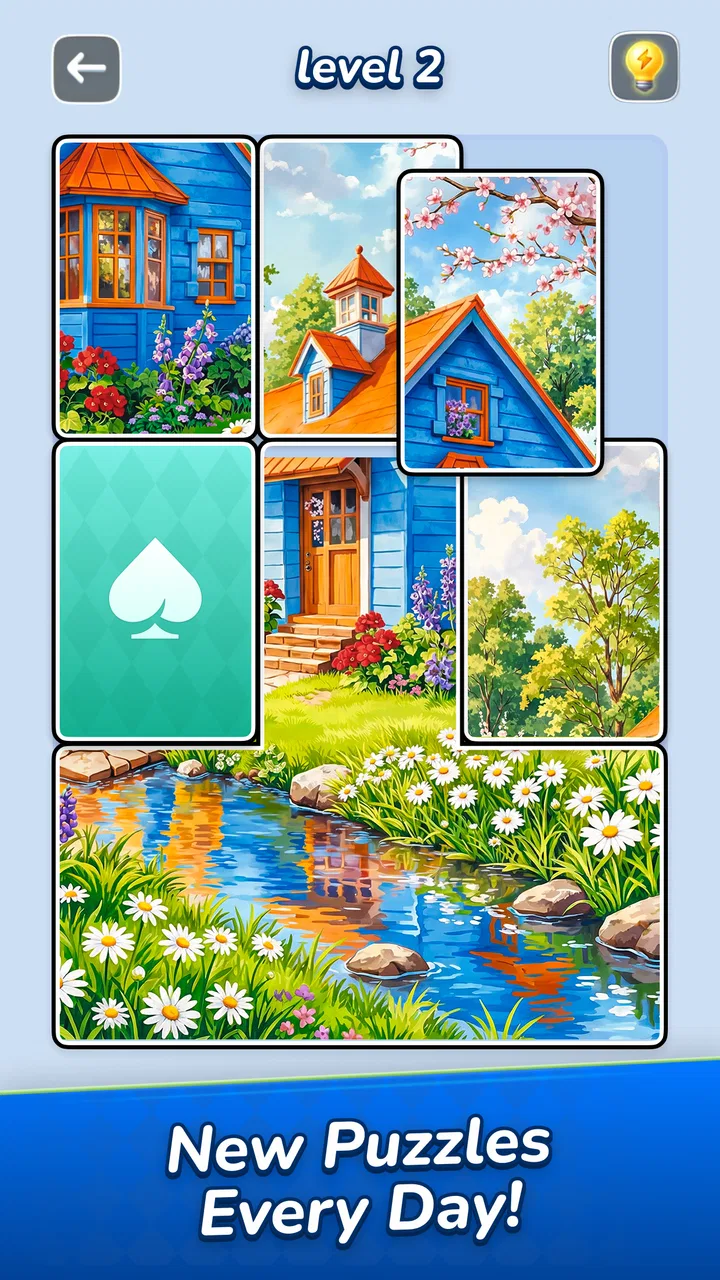
I picked up Jigsawcard Solitaire Puzzle expecting a light card-themed puzzle, and that is exactly where it fits best: a quiet, visual game for short breaks rather than a demanding strategy title. Its basic appeal comes from arranging pieces, matching them, and completing picture-based challenges, but the card presentation gives the familiar jigsaw format a slightly different feel. I found it easy to understand within a few minutes, while still offering enough visual focus to make a completed board feel satisfying.
This is a free puzzle game from Oakever Games, aimed at an Everyone audience. It has built a strong early audience, with a 4.7 average from around 138 thousand ratings and more than a million installs. Those figures do not automatically make it the right choice for everyone, but they do suggest that the simple format is connecting with a broad group of players. I would recommend trying it if you enjoy relaxed picture puzzles and want something more tactile than a standard solitaire layout.
How the current version feels to play
The central loop is straightforward: I choose a challenge, move visual pieces into place, match what belongs together, and work toward a finished image. The game’s identity comes from combining the familiar rhythm of a jigsaw with card-like pieces. That combination makes each board feel more compact and organized than a traditional puzzle spread across a table, which is useful when playing on a phone.
You May Also Like

 Blood Strike: 2.5 Anniversary
Blood Strike’s Loadouts Turn Every Drop Into a Tactical Gamble
A close look at Blood Strike’s custom loadouts: how fast access to signature weapons reshapes its battle royale rhythm, rewards preparation, and narrows the gap between fights.

 Pandora - Music & Podcasts
Pandora’s Music Is Easy to Start, but Harder to Recover
Pandora’s strength is its low-effort path from a seed to a station. Its weak spot is how much confidence it asks you to place in connection, setup, and quiet recovery.

 8 Ball Pool
 Is Built on Rivalries, Rematches, and Routine
A close look at the rivalries, rematches, shared routines, and unanswered safety questions that turn a quick pool match into a persistent mobile community.

 Samsung Music
’s Quiet Strength Is Playing What You Already Own
Its reach comes less from spectacle than from dependable access to a personal library. That simplicity is both the app’s strongest retention engine and its ceiling.

 AccuWeather: Weather Radar
AccuWeather Review: A Quick, Clear Forecast for Everyday Decisions
For everyday plans, the best forecast is the one you can understand quickly. AccuWeather makes rain timing, radar, and local conditions easy to act on, with a few trade-offs.

 Hill Climb Racing
Why Hill Climb Racing Still Turns Crashes Into One More Run
A tiny car, a bumpy hill and one more upgrade: Hill Climb Racing keeps resurfacing because its simple chaos makes every near-miss feel personal.
More From Our News Desk



What I like most is the low barrier to entry. There is no complicated rulebook to study before starting, and the visual goal is always clear. I can open the game during a short wait, make progress without committing to a long session, and stop when I feel finished. That makes it a good companion for a commute, a coffee break, or the last few minutes before bed.
The trade-off is that the experience depends heavily on whether you enjoy repetition. The basic actions remain familiar from one challenge to the next, so players looking for a constantly changing puzzle system may eventually want more variety. I did not see this as a flaw in the game’s intended style, but it is an important distinction: this is a calming sorting activity, not a deep logic game with many different rule sets.
The visual approach also changes how I think about difficulty. In a conventional jigsaw, shape and color are usually the main clues. Here, the card-like presentation encourages me to inspect the artwork, edges, and nearby matches together. When I slowed down and grouped pieces by color or image detail before placing them, I made fewer unnecessary moves. That small habit is more useful than trying to solve the board randomly.
A practical way to play without making it feel like work
My most effective routine was to begin by scanning the whole board instead of immediately tapping the first piece that looked familiar. I looked for distinctive colors, strong lines, and obvious image fragments, then handled the easiest matches first. This creates a few reference points and makes the less recognizable pieces easier to judge later.
For a short session, I would focus on completing a small portion rather than forcing the entire challenge. That keeps the game relaxing and avoids turning a casual activity into a task. If I had more time, I grouped similar-looking pieces mentally before placing them. This is especially helpful when several cards share the same background tone or pattern.
Another useful approach is to treat the finished image as a visual map. Instead of viewing each card in isolation, I asked what kind of scene or object the piece seemed to belong to. A bright edge, a repeated texture, or a change in direction can reveal its position more quickly than color alone. This is a small but meaningful advantage for players who prefer observation over trial and error.
Where it fits among familiar puzzle alternatives
Compared with a traditional jigsaw app, this game feels more compact and card-oriented. A traditional digital jigsaw may appeal more to someone who wants a large, open board and the sensation of handling many loose pieces. Jigsawcard Puzzle is better suited to someone who prefers a cleaner, more focused arrangement on a phone screen.
It also differs from classic solitaire. Solitaire is usually about planning a sequence of moves under strict card rules, while this game uses cards as part of a visual assembly challenge. If you want tactical decisions, probability management, or a familiar win condition based on suits and ranks, a dedicated solitaire game will be the stronger choice. If you want to match images and build a picture at your own pace, this title is closer to what you are looking for.
Compared with match-three puzzles, the pace is less frantic. There is no need to chase a chain of quick combinations or react to a rapidly changing board. That makes it a better fit for players who find timed or highly animated puzzle games tiring. On the other hand, anyone who needs constant movement, sound, or escalating pressure may find the calm presentation too restrained.
What the version and release information tell me
The game is currently listed as version 1.4.1, and it was released on November 14, 2025. Those details matter because this is a relatively recent puzzle experience rather than a long-established classic that has accumulated years of systems and content. I approached it as a focused product whose main job is to make picture assembly pleasant and accessible.
The current version is available for devices using Android 7.0 or later. That gives it a reasonably broad technical reach for Android users, including people who are not using a brand-new phone. I would still check the device’s available storage and general performance before installing any game, especially on older hardware, but the operating-system requirement itself is not especially demanding.
The release timing also gives the game room to develop. I would watch future updates for meaningful improvements to puzzle variety, organization, and the overall flow between challenges. I would be more interested in useful refinements than in features added simply to make the interface busier. For this kind of game, a smoother browsing experience can matter just as much as a larger collection.
How existing players may experience the current build
For someone installing it now, the main benefit is that the core idea is immediately readable. Existing players who already enjoy the card-and-jigsaw format should feel comfortable returning because the central activity does not require relearning a complex system. The game’s strength is consistency: I know what kind of concentration it expects, and I can decide quickly whether I have the mood for it.
That consistency can also expose the current limits. Once I understand the best way to sort pieces, some boards may feel more like a familiar routine than a fresh puzzle. Players who have already spent a lot of time with the game may therefore value new image types or more varied challenge structures more than small visual adjustments.
One thing I appreciated is that the game can serve different attention levels. On a distracted day, I could make obvious matches and still feel progress. When I wanted more involvement, I deliberately avoided guessing and tried to infer each piece’s place from the image. The same basic board can therefore feel either casual or moderately absorbing, depending on how carefully I choose to play.
A realistic everyday use case is a short evening break after work. I can play a few moves while waiting for dinner or winding down, without needing to remember a complicated campaign or recover from a failed attempt. It is also suitable for someone who wants a screen activity that rewards patience rather than speed. I would not use it as my main game during a long session unless I already knew that I enjoyed repetitive visual sorting.
Small habits that improve the experience
I recommend keeping the phone at a comfortable viewing distance and avoiding very fast tapping. The artwork is part of the puzzle, so rushing can make similar pieces seem interchangeable. A slower scan often saves time because it reduces the number of placements that need to be reconsidered.
It also helps to separate “certain” matches from “possible” matches in your mind. I placed pieces only when the image relationship looked convincing, then used those confirmed placements to interpret the uncertain ones. This prevents a common frustration in visual puzzles: building an entire section around one attractive but incorrect guess.
If you are playing while tired, choose the game for its relaxing rhythm rather than expecting a strong mental workout. The experience is most enjoyable when I let the board unfold gradually. Trying to optimize every move can remove the very calmness that makes this format appealing.
For parents considering it for a child, the Everyone content rating makes the game broadly approachable. Still, the best fit depends on the child’s patience and comfort with visual matching. A child who prefers fast action may lose interest, while one who enjoys arranging pictures can find the simple rules reassuring. I would introduce it as a quiet puzzle activity, not as an educational tool or a competitive challenge.
Where the game still has room to improve
The biggest potential weakness is variety. The central mechanic is pleasant, but it cannot carry unlimited interest by itself. Players who need new rules, changing objectives, or a stronger sense of progression may find the experience narrow. In that case, a broader puzzle collection with logic, word, number, and spatial challenges would offer more long-term contrast.
There is also a difference between being easy to start and being rewarding for advanced puzzle fans. Beginners benefit from the clear visual goal, but experienced players may want more control over challenge intensity. A game like this works best when it gives relaxed users a comfortable pace while still offering careful players something to master.
The card format can create occasional visual ambiguity. Pieces with similar colors or textures may require close inspection, and small-screen play can make that more noticeable. I found that enlarging the view mentally by holding the phone a little closer helped, but this is still a consideration for people with limited eyesight or for anyone playing on a particularly small display.
I would also avoid choosing it if your priority is social competition. Its appeal is personal concentration and completion, not the excitement of comparing complex scores or coordinating with other players. For social play, a multiplayer puzzle or a competitive solitaire mode would likely be more suitable.
Who should install it, and who should skip it
I think this is a good choice for casual puzzle fans, people who enjoy picture assembly, and players who want a free game that can be understood immediately. It is especially appealing if you like the visual satisfaction of completing an image but prefer a phone-friendly card arrangement instead of a sprawling jigsaw table.
I would suggest skipping it if you are searching for a story-driven game, a demanding brain teaser, or a traditional solitaire experience. It is also not the best option for someone who becomes bored when the same basic interaction remains at the center of every session. A more varied puzzle app would provide better value for that player’s attention.
The free price makes experimentation easy, and the broad age rating removes much of the hesitation around trying it as a family-friendly casual game. Even so, free does not mean universally suitable. The real question is whether you enjoy slow visual decisions and repeated image assembly. If you do, the lack of a complicated learning curve is a genuine advantage.
What I would watch in future updates
Because the game is still early in its life, I would pay attention to how Oakever Games develops the puzzle library and handles the everyday usability of the current build. The most valuable improvements would be those that make browsing, selecting, and returning to challenges feel more organized without taking attention away from the board.
I would also look for signs that the developer is responding to the needs of both newcomers and regular players. New users need clear entry points and comfortable pacing. Returning users need enough visual or structural variation to keep familiar actions from becoming automatic. Balancing those groups will determine whether the game remains a pleasant short-break title or grows into a more lasting puzzle destination.
My current view is positive but measured. The game succeeds because it keeps picture-based puzzling simple, tactile, and easy to fit into ordinary moments. Its limitations are tied to that same simplicity, so I would not recommend it as an all-purpose puzzle replacement. For the right player, though, version 1.4.1 offers a clean reason to install it: a free, approachable way to slow down, sort visual clues, and enjoy the small satisfaction of seeing a scattered image come together.
After using it, I would recommend giving it a fair trial with several short sessions rather than judging it after one board. The appeal is not a dramatic first impression; it is the way the game settles into a comfortable rhythm. If that rhythm suits you, Jigsawcard Puzzle can become a dependable little break in the day. If you need constant novelty or deeper strategy, you will probably be happier with a different puzzle category.
FAQs for Jigsawcard Solitaire Puzzle
01What is Jigsawcard Solitaire Puzzle?
Jigsawcard Solitaire Puzzle is a unique blend of classic solitaire gameplay and jigsaw puzzle elements. Players engage their strategic thinking by solving card-based puzzles while enjoying the relaxing and satisfying experience of completing a jigsaw. This app offers a refreshing twist to traditional card games, making it both entertaining and mentally stimulating.
02How does the game combine solitaire and jigsaw puzzle elements?
The game combines solitaire and jigsaw puzzle elements by allowing players to reveal parts of a larger image as they progress through solitaire challenges. Each completed card sequence unlocks pieces of a puzzle, adding an engaging visual component to the traditional card game. This fusion keeps the gameplay fresh and exciting for fans of both genres.
03Are there different levels or difficulty settings in Jigsawcard Solitaire Puzzle?
Yes, Jigsawcard Solitaire Puzzle offers multiple levels with varying difficulty settings. Players can choose from beginner levels for a more relaxed experience or challenge themselves with advanced levels that require strategic planning and skill. This variety ensures that both casual players and seasoned solitaire enthusiasts can enjoy the game.
04Does Jigsawcard Solitaire Puzzle offer any in-app purchases or ads?
Jigsawcard Solitaire Puzzle may include in-app purchases that allow players to buy hints, extra lives, or unlock additional levels. The game might also feature ads, but they are typically minimal and non-intrusive. Players can often opt for a premium version to enjoy an ad-free experience and additional features.
05Can I play Jigsawcard Solitaire Puzzle offline?
Yes, Jigsawcard Solitaire Puzzle is designed to be played offline, allowing users to enjoy the game without an internet connection. This feature makes it an ideal choice for playing during commutes or in areas with limited connectivity. However, certain features, such as leaderboards or updates, may require a connection.
Pros
- Engaging and challenging puzzles.
- Smooth and intuitive user interface.
- Variety of card designs available.
- Regular updates with new levels.
- Offline play mode supported.
Cons
- Contains frequent in-app ads.
- Limited hints without purchase.
- No multiplayer mode available.
- Requires iOS 11 or later.
- Large app size may affect storage.

Jigsawcard Solitaire Puzzle
Gallery